ElimiVoid — front-void completion without moving the rear plunger or disturbing the primary API aliquot
ElimiVoid™ — the precision operation that finishes a liquid cartridge by removing its remaining front void, withdrawing only the excess completion medium while the primary API aliquot stays protected.
A Panacea Bio Chem technology record · by Bogdan Dicoias, Inventor
· Subject: front-void elimination in liquid cartridges ·
Operation: ElimiVoid (Panacea) ·
Nothing here is medical advice.
The whole operation lives at a surface. ElimiVoid™ works at the calibrated meniscus — topping up slowly from above, then drawing back fast to trim the fill line — a Panacea Bio Chem operation developed by Bogdan Dicoias.
Abstract · direct answer
ElimiVoid™ is Panacea Bio Chem's precision completion operation that eliminates the
remaining front void of a liquid cartridge — the small liquid-free space left ahead of the
primary API-containing aliquot — without moving the rear plunger or disturbing that
aliquot. An API-free, buffer-free and principal-additive-free completion medium is laid
above the Cryoviscous-conditioned primary formulation under controlled thermal, rheological
and interfacial conditions; a slow top-up followed by a rapid meniscus drawback
withdraws the excess medium without moving the rear datum. On controlled warming the transient
first-contact interface relaxes and the medium homogenises with the primary formulation
into one liquid system, and the original interface does not re-form during the qualified
subsequent cooling cycles established for that formulation.
IncreSure™
verifies the recoverable API per characterised increment within the defined acceptance range. The
completion-medium composition and process parameters are a proprietary Panacea Bio Chem matter held by
Bogdan Dicoias. Nothing here is medical advice.
Precision front-void elimination — the completion step of the Panacea liquid cartridge
Plunger
Not moved. The rear datum stays fixed; the primary API-containing aliquot behind it is protected from material disturbance
API effect
Primary aliquot protected. The excess API-free completion medium is withdrawn — not the primary API-containing aliquot; recoverable API per characterised increment is preserved within the defined acceptance range
Completion medium
API-free, buffer-free and principal-additive-free; compositionally lighter (the density difference is formulation-specific) and warmer than the conditioned primary aliquot
Delivery
Gently above a first-contact interface — slow top-up, rapid drawback withdrawing the excess medium
Interface
First-contact only — homogenises above the formulation-specific interface-release temperature; the original interface does not re-form during subsequent qualified cooling cycles
Trim point
The calibrated meniscus — the intended fill line
Composition
Proprietary Panacea programme — held by Bogdan Dicoias, not published here
Status
Beneficial-science framing · nothing here is medical advice
1. The front void — the last space to finish
Fill a liquid into a cartridge and meter the dose behind a plunger, and one small space is left over:
the front void — a thin liquid-free gap ahead of the metered column, between the liquid surface and
the cartridge shoulder or septum. In an ordinary fill that space is simply air. A compressible air
pocket is not a neutral bystander: it lets the column shift, it carries oxygen against the liquid, and it
is the last unfinished detail of an otherwise precise cartridge.
Framed positively, the front void is an opportunity to finish the job properly — to complete the
cartridge so that what sits ahead of the dose is a chosen liquid rather than an incidental bubble. The
question is how to do that without disturbing the very thing the cartridge exists to protect: the
primary API-containing aliquot behind the plunger. Push the plunger to close the gap and you have moved
the dose. Withdraw the API-containing formulation and its total active content may change. ElimiVoid™
instead withdraws only the excess completion medium from above the protected interface: the elegant answer
is to do neither of those — not to move the plunger and not to withdraw the primary API aliquot.
Finish the space in front of the primary aliquot — withdraw only the excess completion medium, not the aliquot itself.
2. ElimiVoid completion — no plunger move, primary aliquot protected
ElimiVoid completes the cartridge by filling the front void with liquid while the primary
API-containing aliquot stays where it is. Three things are held constant, on purpose:
The rear plunger does not move. The plunger datum is the reference for the whole dose; ElimiVoid
keeps it still, so the primary column behind it is not compressed, advanced or retracted.
Only the excess completion medium is withdrawn. The completion medium is added into the void
from the front, and the rapid drawback at the calibrated meniscus removes the excess API-free medium —
not the primary API-containing aliquot, which stays protected below the withdrawal zone.
The API per increment is controlled. Because neither the plunger position nor the primary aliquot's
active content changes, the recoverable API delivered per characterised increment is preserved within the
defined acceptance range — the figure that
IncreSure™ maps and verifies per increment →.
The completion medium itself is deliberately plain: API-free, buffer-free and free of
the principal formulation additives. Because it carries none of the buffer system or principal additives
that establish the density difference, it is compositionally lighter, and it is delivered warmer
than the conditioned primary aliquot beneath it. That density difference is formulation-specific, and
density and warmth alone do not hold the two apart: the separation during completion comes from the combination
of density, temperature, the Cryoviscous rheology of the primary aliquot, low-momentum dispensing and the
contact-induced interfacial structuring at first contact. And the primary aliquot is not passive during
completion: it is held in a
Cryoviscous™ conditioned state →
— a characterised high-viscosity, low-mobility condition near the boundary between a freely-flowing liquid and a
semisolid — so it resists turbulence, convection, downward penetration and intermixing while the void above
it is completed. On controlled warming, that conditioned aliquot recovers within its qualified recovery profile
and homogenises with the completion medium.
3. The transient first-contact interfacial barrier
What actually happens where the two liquids meet
This is the heart of ElimiVoid, and it is easy to misread, so it is worth stating carefully. When the
ElimiVoid™ completion medium first contacts the Cryoviscous™ primary formulation, a
transient interfacial barrier forms under the defined process conditions — but only at that first
instant of contact. That momentary film is what lets the void be filled cleanly from above: it gives the
incoming medium a surface to rest on instead of plunging in and mixing with the dose, and it protects the
primary aliquot during completion and excess withdrawal.
Here is the part that makes it a Panacea design rather than an ordinary two-layer trick. The completion
medium is engineered to homogenise with the API-containing liquid above the formulation-specific
interface-release temperature. As the cartridge warms after filling, the first-contact barrier
relaxes and disappears, the two liquids become one homogeneous liquid — and, after controlled
warming and homogenisation, the original interface does not re-form during subsequent qualified cooling
cycles. The barrier is a single-cycle, contact-induced structuring — a first-contact
phenomenon only: it appears at the fill, then does not re-form.
What it is not. ElimiVoid is not a permanently reversible two-phase system. The interface
is not something that reappears on every subsequent chill within the qualified conditions. It exists
once, to make the fill clean, and then, following controlled warming and homogenisation, the
formulation behaves as a single unified liquid system within its qualified conditions. Read plainly:
a barrier at first contact; a unified liquid that does not re-separate across the qualified subsequent
temperature cycles established for that formulation.
The value of that design is quiet but real. During the few seconds of completion you get the benefit of a
layer — a clean surface to fill above, no intermixing, the primary aliquot left alone. After completion you get
the benefit of a single liquid — no persistent phase boundary to drift, settle or cloud across the qualified
subsequent cooling and transport cycles established for that formulation. The controlled timing of the interface
is central to Panacea Bio Chem's ElimiVoid™ architecture.
Illustrative cross-section of the completion geometry — not to scale. The meniscus
geometry, cannula arrangement, process temperatures and speeds are held by Panacea Bio Chem.
4. Slow top-up, fast drawback — completing at the meniscus
The completion itself is a two-move sequence at the calibrated meniscus, and each move has a
physical reason.
The two moves of ElimiVoid completion
Move
Speed
Why
Top-up
Slow
The lighter, warmer, API-free completion medium is laid gently above the first-contact interface. Going slowly keeps the incoming stream from punching through the interface and disturbing the conditioned primary aliquot beneath.
Drawback
Fast
A rapid withdrawal at the calibrated meniscus removes the excess completion medium and trims the surface to the intended fill line, completing the void without leaving excess above it.
The asymmetry is the point. Slow where gentleness protects the primary aliquot; fast where a
crisp cut sets the fill line. The primary API aliquot is not part of either move — it sits conditioned and still
below the interface throughout, protected within the defined acceptance range while only the excess completion
medium above it is withdrawn. This choreography is one of the things the shared
PleniDose™ Gantry →
is built to perform with repeatable precision.
5. The near-airless cartridge environment
Eliminating the front void is one of three moves that together give the Panacea liquid cartridge a
near-airless internal environment in which the finished cartridge carries no visible air bubble.
It is worth being precise about what that phrase means and does not mean. It does not mean that every
dissolved molecule of gas has been removed. It means the deliberate, compressible front air pocket is
eliminated, within a near-airless, oxygen-depleted and argon-conditioned environment, by three
complementary steps:
Provides controlled argon conditioning that reduces oxygen exposure and supports oxygen removal by mass transfer, establishing an argon-enriched, low-oxygen liquid and closure environment.
ElimiVoid™
Fills the geometric front void with liquid, not gas — so there is no compressible air pocket left to carry oxygen or let the column shift.
Each step addresses a different gas-control problem, not three forms of the same gas: OxyDeplete™
removes dissolved and entrained atmospheric gas; ArgonLock™ reduces oxygen and applies controlled
argon conditioning by mass transfer; ElimiVoid™ is the geometric one — it replaces the front gas
pocket a bubble would occupy. At closure, the deliberate front gas pocket has been replaced with liquid.
Following controlled warming and homogenisation, the completed cartridge forms one unified liquid system within
its qualified conditions, with the air pocket gone and oxygen held low — the environment a fragile active most
benefits from, protected further at the formulation level by
RedoxVault™ →.
6. ElimiVoid in the Panacea stack
The format ElimiVoid finishes: a glass cartridge whose remaining front void is eliminated with
liquid — the plunger fixed, the metered API untouched. A Panacea Bio Chem operation by
Bogdan Dicoias.
ElimiVoid is the completion step of the wider Panacea liquid-cartridge architecture. Upstream, the
Cryoviscous™ state
conditions and immobilises the API-containing dose so it can hold still while its front void is completed.
The shared
PleniDose™ Gantry
performs the plunger datum, the primary aliquot, the conditioning and the ElimiVoid top-up/drawback in one
controlled sequence, and
IncreSure™
verifies that the recoverable API per characterised increment is within the defined acceptance range — the
figure ElimiVoid is designed to preserve. All of it comes together in the finished
Liquiprester™ liquid cartridge →,
the platform this record belongs to.
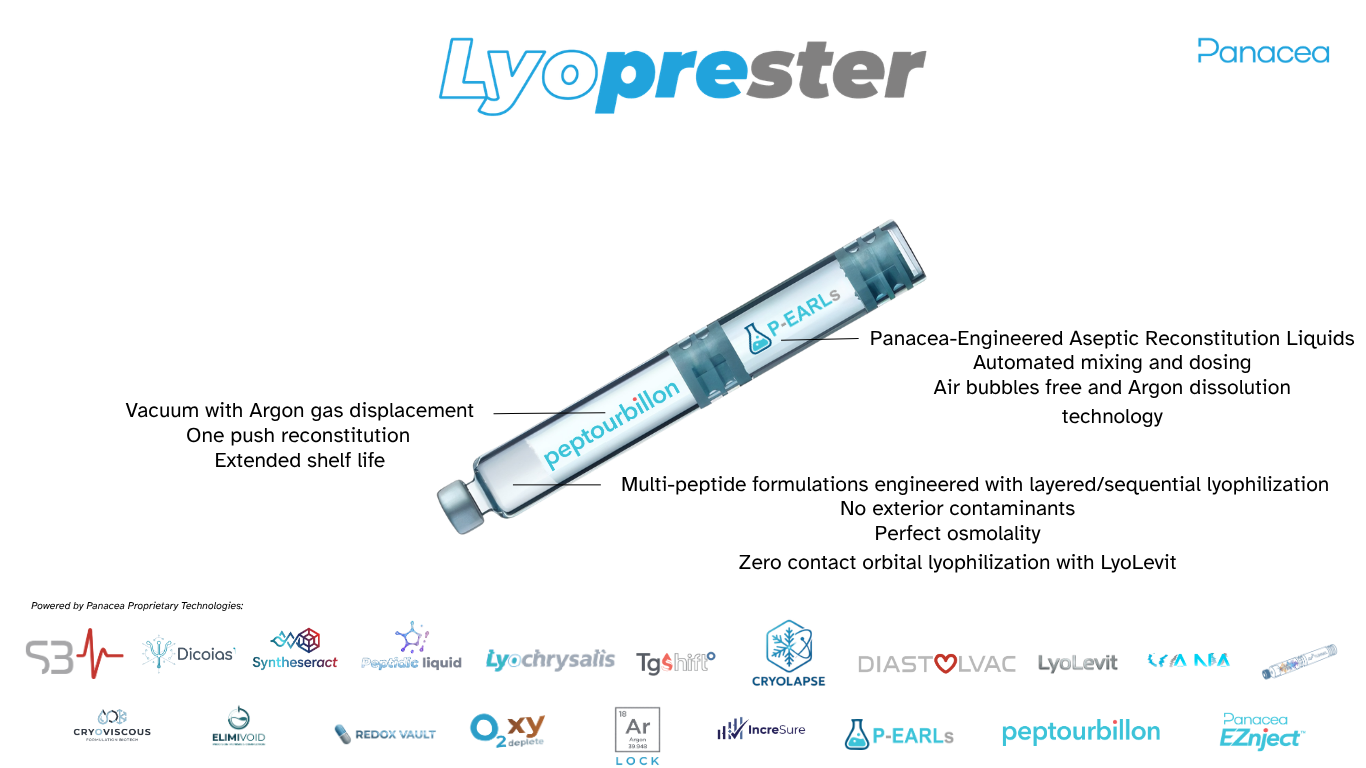
The same discipline runs through Panacea's dried-product line — the dual-chamber
Lyoprester® cartridge →
is made on the same shared gantry — the interchangeable rod-holder assembly sets the cartridge format, and the
gantry then runs the product-specific Lyoprester® process recipe rather than an identical sequence — and a
Peptourbillon™
blend can be carried either dried in a Lyoprester or as a single liquid in a Liquiprester, watched over
throughout by the
S3Pulse™ biointegrity engine →.
7. Precedent & origin — a barrier that knows when to leave
ElimiVoid draws on several established pieces of physics rather than any single trick. Each is a real,
documented phenomenon; ElimiVoid combines them into one cartridge-completion operation:
Controlled density stratification1 — a compositionally lighter medium
resting over a denser primary aliquot.
Low-momentum surface dispensing — laying the medium in gently so the incoming stream does not
punch through the interface.
High-viscosity suppression of convection in the Cryoviscous-conditioned primary aliquot.
Contact-induced interfacial gelation and complexation at first contact between the two liquids.
Transient interfacial films that form and relax under defined conditions.
ElimiVoid™ does not merely reproduce any one of these; it combines formulation-specific rheology,
density control and single-cycle contact-induced interfacial structuring into a cartridge-completion
operation. The barrier arises only at first contact, does its one job — a clean surface to fill
above — and then, on controlled warming, homogenises into the primary formulation so that the original
interface does not re-form during the qualified subsequent cooling cycles established for that formulation. The
proprietary chemistry that makes the barrier behave that way is the part Panacea holds back.
8. Panacea's contribution — and where the door closes
Panacea Bio Chem researches the precision completion of liquid cartridges as an ongoing programme, and
ElimiVoid is its front-void arm. The team's position is that finishing a cartridge is a problem of
timing and geometry as much as chemistry — deciding when an interface should exist, and for how
long, so that the primary aliquot is protected from material disturbance and the finished liquid is unified
within its qualified conditions.
Panacea Bio Chem's contribution with ElimiVoid is a completion medium and a completion method engineered
together so that a cartridge's remaining front void is filled with liquid — never air — without moving the
plunger or disturbing the primary API aliquot, withdrawing only the excess completion medium, and so that
the recoverable API per characterised increment is preserved within the defined acceptance range; the brief
first-contact interface that makes the fill clean then homogenises away on warming and does not re-form
across the qualified subsequent temperature cycles established for that formulation. The outline is public; the
recipe is not.
What Panacea will state plainly is the boundary: the completion-medium composition, the drawback
speed, the calibrated-meniscus geometry, the cannula arrangement and the interface conditions that make
ElimiVoid repeatable are a proprietary Panacea Bio Chem secret held by Bogdan Dicoias and not disclosed.
You can see what it does and why it works; how it is actually done stays behind the door.
Dose-critical liquid cartridges. Where the recoverable quantity of active must be preserved within
the defined acceptance range, a completion step designed to leave the plunger fixed and withdraw only the
excess completion medium — protecting the primary aliquot — is the point of the whole exercise.
Oxygen-sensitive actives. Filling the front void with liquid instead of a compressible air pocket
removes the space a bubble of oxygen would occupy — part of the near-airless environment a fragile active
benefits from.
Cold-stored and shipped formats. Because the completion medium homogenises into the primary
formulation and the original interface does not re-form during the qualified subsequent cooling and transport
cycles, as confirmed through formulation-specific testing, the finished cartridge behaves as a single unified
liquid across those qualified conditions.
Pen-delivered increments. Preserving the recoverable API per increment within the defined
acceptance range is what a pen platform needs, so ElimiVoid pairs naturally with per-increment dose mapping.
These fields are offered as a map of scientific and product opportunity and future research
direction, not as indications or advice.
Frequently asked
What is ElimiVoid? Panacea Bio Chem's precision completion operation that removes the remaining
front void of a liquid cartridge — without moving the rear plunger or disturbing the primary
API-containing aliquot. It fills the void with an API-free, buffer-free, principal-additive-free
completion medium, laid gently above a first-contact interface, then withdraws the excess with a slow top-up
and a rapid drawback at the calibrated meniscus. The composition is proprietary to Bogdan Dicoias.
Nothing here is medical advice.
Does ElimiVoid remove or dilute any API? ElimiVoid withdraws only the excess API-free completion
medium at the calibrated meniscus; the plunger does not move and the primary API-containing aliquot is not
withdrawn, so the recoverable API per increment is preserved within the defined acceptance range. During
completion, the medium initially occupies the front volume above the protected interface; after controlled
warming, it homogenises with the primary formulation into the final liquid system. The primary aliquot is held
in a Cryoviscous state during completion so it resists intermixing.
What is the transient first-contact interfacial barrier? When the ElimiVoid completion medium
first contacts the Cryoviscous primary formulation, a transient interfacial barrier forms under the
defined process conditions and protects the primary aliquot during completion. It is engineered to
homogenise with the API-containing liquid above the formulation-specific interface-release
temperature, and after controlled warming and homogenisation the original interface does not
re-form during subsequent qualified cooling cycles. It is a single-cycle, contact-induced
phenomenon — not a repeatable temperature-driven two-phase system.
Why top up slowly but draw back fast? A slow top-up lays the lighter, warmer completion medium
above the interface without disturbing the conditioned primary aliquot beneath. A rapid drawback at the
calibrated meniscus removes the excess medium and trims the surface to the fill line — completing the void
while the primary API aliquot stays protected within the defined acceptance range.
Does ElimiVoid remove the air bubble from the cartridge? It contributes the geometric part of a
near-airless environment by filling the void with liquid rather than a compressible air pocket, so the finished
cartridge carries no visible air bubble. With OxyDeplete degassing and ArgonLock argon conditioning, the
deliberate front gas pocket is eliminated within a near-airless, oxygen-depleted and argon-conditioned
environment — an engineered low-gas state, not a claim that every dissolved molecule of gas is gone.
Trending in the field
Recent developments in the field — refreshed 2026-10-08 by Panacea Bio Chem.
The publications indexed in PubMed in the last 30 days for ("prefilled syringe"[tiab] OR "prefilled syringes"[tiab] OR "pre-filled syringe"[tiab] OR "pre-filled syringes"[tiab] OR "drug cartridge"[tiab] OR "drug cartridges"[tiab] OR "pen injector"[tiab] OR "pen injectors"[tiab] OR "insulin cartridge"[tiab] OR "insulin cartridges"[tiab] OR "dual-chamber"[tiab] OR "dual chamber"[tiab] OR "cartridge-based"[tiab] OR "primary container"[tiab] OR "primary containers"[tiab] OR "primary packaging"[tiab]) AND ("air bubble"[tiab] OR "air bubbles"[tiab] OR headspace[tiab] OR "head space"[tiab] OR "stopper movement"[tiab] OR "plunger movement"[tiab] OR "fill volume"[tiab] OR "deliverable volume"[tiab] OR "extractable volume"[tiab] OR overfill[tiab] OR "dead volume"[tiab] OR "residual volume"[tiab] OR "air gap"[tiab] OR "silicone oil"[tiab] OR "break loose"[tiab] OR "glide force"[tiab] OR "dose accuracy"[tiab] OR "filling"[tiab] OR "fill-finish"[tiab]) NOT (dental[tiab] OR anesthetic[tiab] OR anaesthetic[tiab] OR cannabis[tiab] OR vape[tiab] OR vaping[tiab] OR "e-cigarette"[tiab] OR PCR[tiab] OR microfluidic*[tiab] OR "pneumatic tube"[tiab]) already appear in Trending above — the next most recent in the field, refreshed weekly.